
International Whale Shark Day – Species Splash
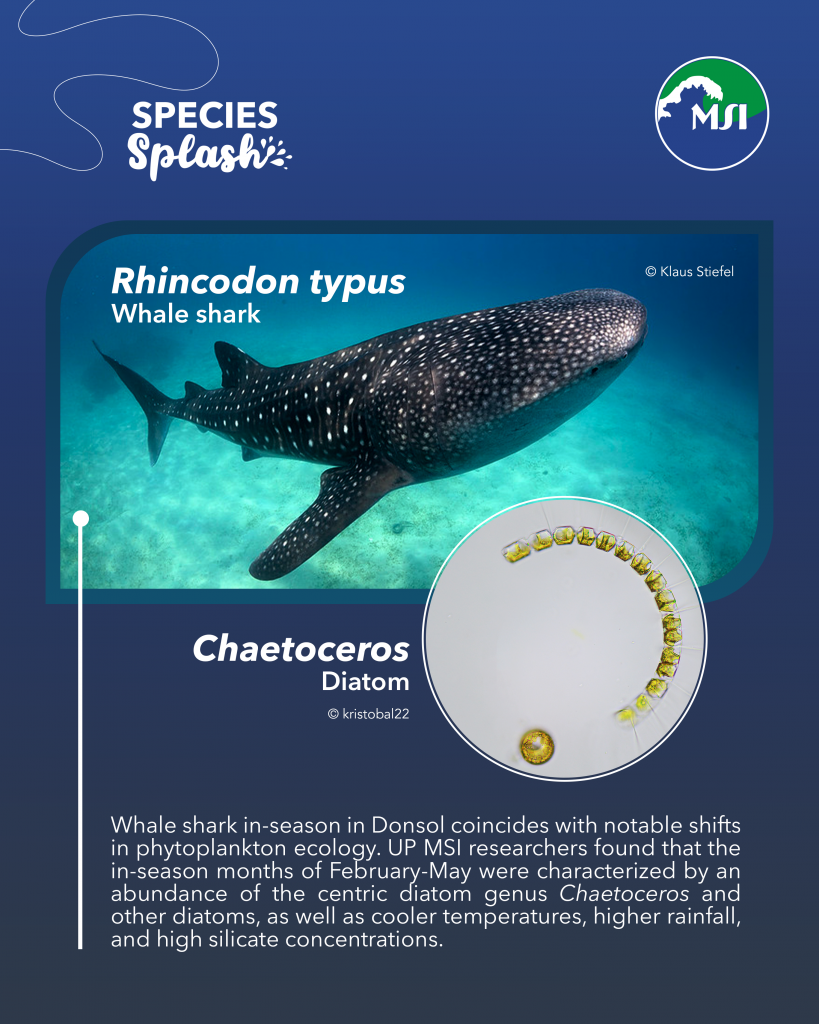
This International Whale Shark Day, we shed light on what draws the beloved butanding to Donsol! A big part of it is the seasonal changes that influence diatom blooms — a special group of phytoplankton.
Gianina Apego and Dr. Aletta Yñiguez of the Biological Oceanography and Modeling of Ecosystem Laboratory worked with Dr. Raphael Kudela of the University of California – Santa Cruz to figure out what made Donsol, Sorsogon such an attractive place for whale sharks to visit every year. The answer was a shift in phytoplankton ecology, a change driven by monsoon rains.
As rainfall increases and temperatures drop around February, diatoms bloom right on time when whale sharks arrive. Most dominant is the centric diatom genus Chaetoceros, followed by the pennate diatom Thalassionema, which is abundant in both the in-season and off-season. These ecological changes are fueled by river runoff, which carries nutrients like silicate, with strong water currents that influence abundance in certain parts of the study area. These diatom blooms create productive conditions for the zooplankton in Donsol’s waters, the main diet of our gentle giants. In contrast, the off-season is characterized by conditions that favor dinoflagellates.
These seasonal changes at the base of the marine food web have a significant effect on our butanding — and, in turn, on the local eco-tourism in Donsol. It just goes to show how something small can make a big difference!
Read the full paper: https://doi.org/10.1016/j.rsma.2024.103898