
Shipworm – Species Splash
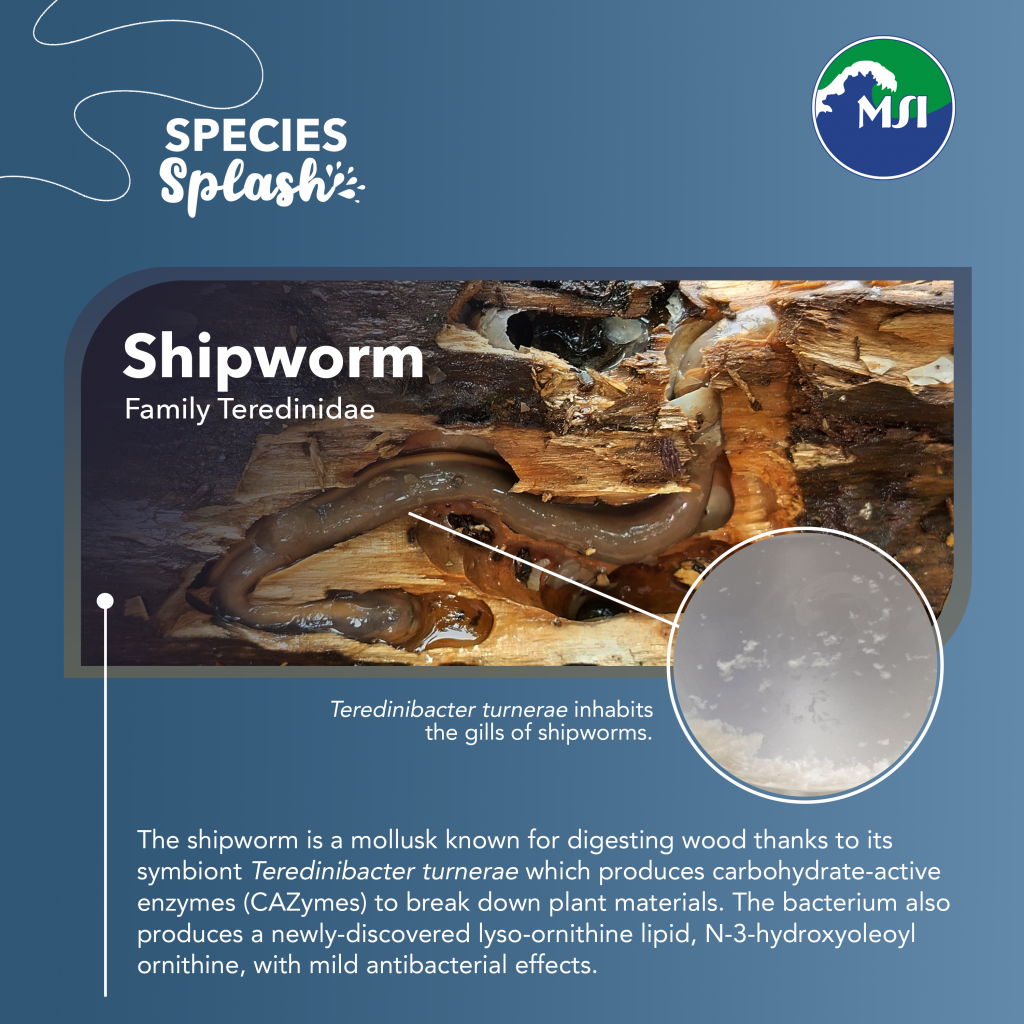
 Twin, where have you been?
”…I’m just in your gills, twin!  ”
”
You read that right! Living inside the gills of the shipworm (family Teredinidae) is its clingy but helpful bestie, Teredinibacter turnerae.
Despite the name, shipworms aren’t actually worms—they’re mollusks! They earned their name from their notorious habit of boring into wooden ships. What sets them apart is their perfect biochemical partnership with T. turnerae, a gram-negative bacterium under the class Gammaproteobacteria. This species helps shipworms digest wood by producing powerful cellulolytic enzymes, and even boosts the shipworm’s immune defense by producing bioactive compounds.
Published in May 2025, a study by UP MSI Prof. Eizadora T. Yu, Ph.D., Joan Catherine A. Chua, Lyle Ijssel P. De Guzman, MSc, and Renato C. Carpina, MSc of the Protein Biochemistry and Biotechnology Lab (PBBL) explored how T. turnerae uses carbohydrate-active enzymes (CAZymes) to break down plant materials. Notably, the bacterium releases only a few enzymes overall and adjusts its “toolkit” based on the plant material. The most complex and powerful mix of enzymes occurred when it came into contact with cellulose, showing just how effective T. turnerae is at processing wood. This study was conducted under the project, “Biofilm-degrading Enzymes from Shipworm Symbionts.”
Meanwhile, published last April is another study where Ernest Guiller S. Pineda, MSc, Prof. Lilibeth A. Salvador-Reyes, Ph.D., and their colleagues from the UP MSI Marine Pharmacognosy Laboratory discovered a new compound from the same bacterium T. turnerae: N-3-hydroxyoleoyl ornithine, a type of lyso-ornithine lipid. Though not a strong antibiotic, it showed mild antibacterial effects and weak toxicity against human kidney and cancer cells due to its ability to disrupt cell membranes. Small but mighty, this compound adds to T. turnerae’s potential in the biomedical field. The study was conducted under the project “Discovery of Small Molecule Compounds from Shipworm Symbionts.”
The shipworms used in both studies were collected from Mabini, Batangas. The two projects were supported by the UP Office of the Vice President for Academic Affairs as part of the Emerging Interdisciplinary Research (EIDR) Program entitled “Targeting Microbial Pathogens Using Specialized Strategies and Bioactive Molecules of Shipworm Symbionts (EIDR C08-09).”
 Read the paper on CAZymes. Read the paper on the new lyso-ornithine lipid. Read Marine Pharmacognosy Laboratory’s post on the new lyso-ornithine lipid.