
Toxopneustes pileolus – Species Splash
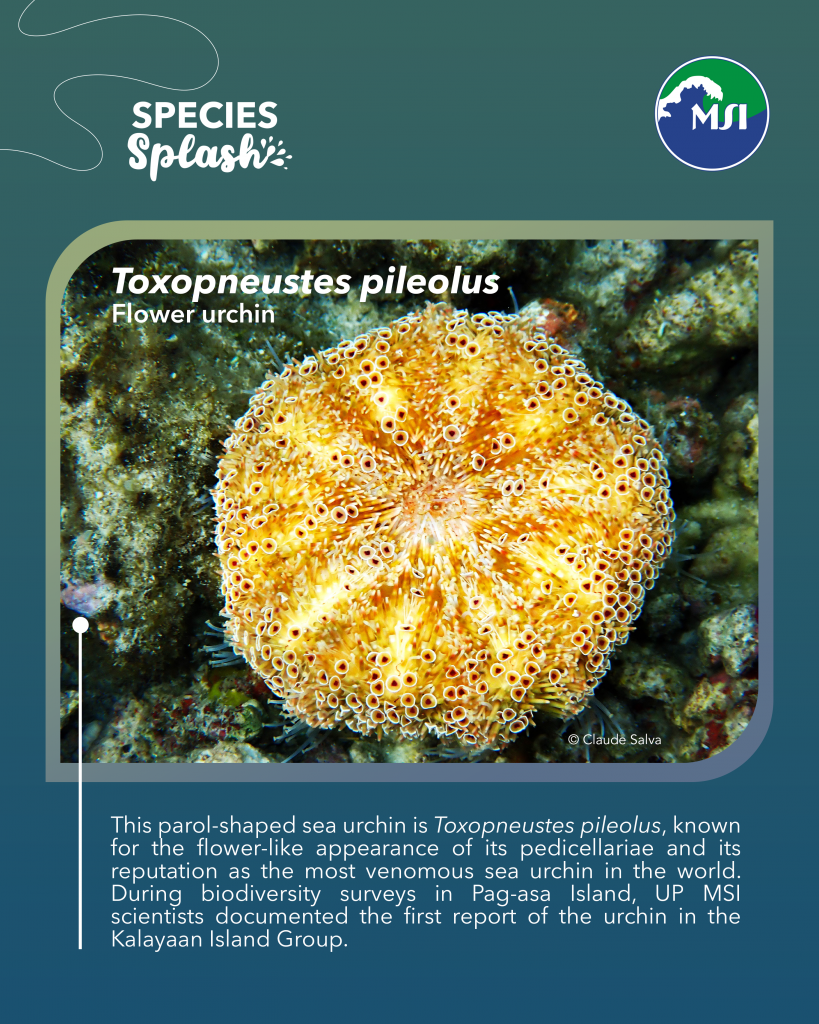
This Christmas, even our oceans are putting up parols! The pentagonal symmetry of sea urchins results in a starry, festive shape for this Toxopneustes pileolus, pictured for the first time in Pag-asa Island. 
Toxopneustes pileolus, also called the flower urchin, is known as the most venomous sea urchin in the world. Its common name comes from the flower-like appearance of its pedicellariae: the tiny circles and triangles around its body, with a reddish dot in the center. These pedicellariae are pincer-like appendages that deliver a venom so strong that the species has the Guinness World Record for “most dangerous sea urchin.” Aside from defense, these urchins also use their pedicellariae for capturing small food particles, removing debris from their bodies, or covering themselves with other materials as a form of sunlight protection.
The first report of Toxopneustes pileolus in the Kalayaan Island Group was done by MSI scientists earlier this 2025. It was a happy discovery during the surveys of Pag-asa Island done through the Integrated Research for Biodiversity Conservation and Carbon Sequestration in the West Philippine Sea (BioConSeq-WPS) project, funded by DENR BMB.
Dr. Maria Celia Malay is leading the project to continue assessing the biodiversity on Pag-asa Island. This follow-up work is currently supported by the Embassy of Canada in the Philippines through the Canada Fund for Local Initiatives (CFLI). Nearly 30 species of echinoderms have already been documented, with shellfish, fishes, and other marine resources that locals harvest from the reef flat for their daily nutrition. This rich biodiversity gives us hope that Pag-asa Island can host a marine protected area in the future.
Meet some of the scientists studying the biodiversity of the West Philippine Sea: https://www.facebook.com/upmarinescienceinstitute/videos/811107138398039/