
Family Portunidae – Species Splash
This Op-Portunidae may be for you! 🎶🫵🦀
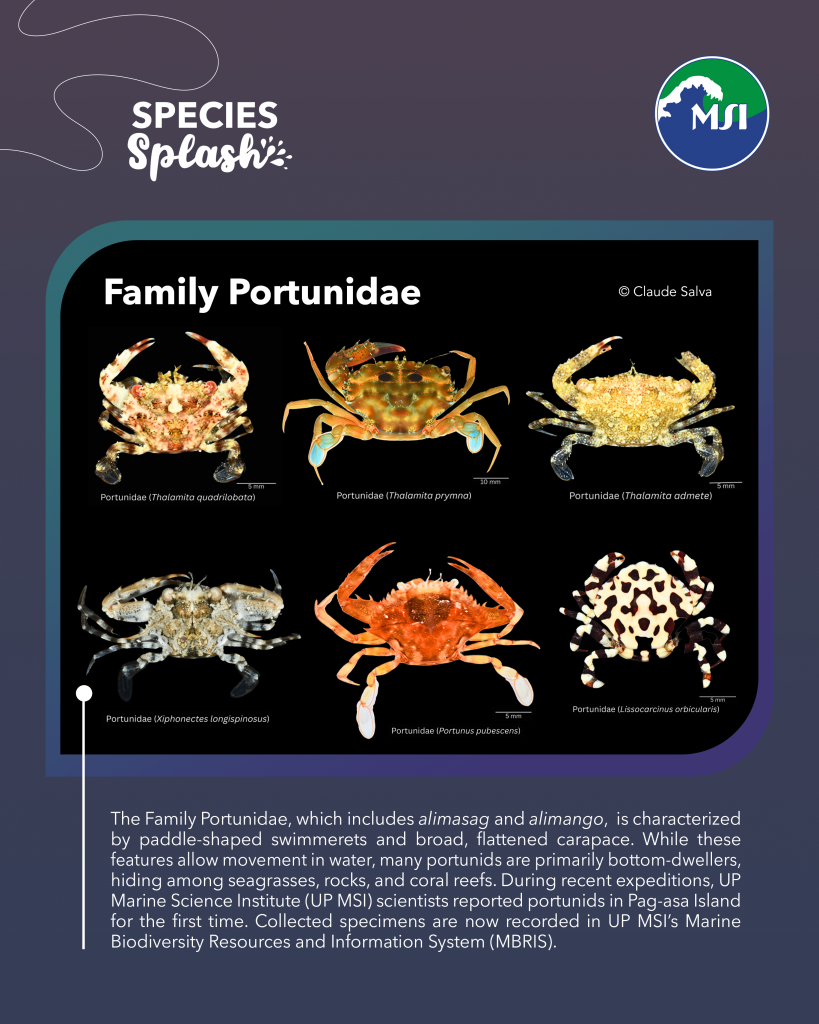
The Family Portunidae is no stranger to Filipinos as some of them are already familiar to us, including alimasag (blue swimming crabs) and alimango (mangrove crabs)! What makes them stand out are their swimmerets, the last pair of legs modified into flat, paddle-shaped appendages. In addition, their carapace (the hard upper shell) is usually flattened and broad. While these features allow them to move easily in water, many portunids are primarily bottom-dwellers, preferring to hide among seagrasses, rocks, and coral reefs.
Many portunids are opportunistic feeders, eating a wide range of food depending on what is available, from decaying organic matter to live prey. Several of the smaller species function as mid-level predators in marine food webs, feeding on organisms such as mollusks, as seen in the blue crab (Prado et al., 2024). However, not all portunids are active predators. Lissocarcinus orbicularis, for example, differs by having a commensal relationship with sea cucumbers, living on them without causing harm (Caulier et al., 2012).
During recent expeditions to Pag-asa Island, scientists from the UP Marine Science Institute (UP MSI) documented portunids in the area for the first time. Species identified from the expedition include Thalamita admete, Thalamita quadrilobata, Xiphonectes longispinosus, Portunus pubescens, and Lissocarcinus orbicularis.
Collected specimens are now recorded in UP MSI’s Marine Biodiversity Resources and Information System (MBRIS), strengthening the baseline data for marine life in the West Philippine Sea. These surveys were conducted under the DENR Biodiversity Management Bureau (BMB) project BioConSeq–WPS. Continued research on Pag-asa Island is currently supported by the Embassy of Canada in the Philippines through the Canada Fund for Local Initiatives (CFLI).
References:
Bowling, B. (n.d.). Portunidae – Swimming Crabs. Texas Parks and Wildlife Department. https://txmarspecies.tamug.edu/invertfamilydetails.cfm…
Caulier, G., Parmentier, E., Lepoint, G., Van Nedervelde, F., & Eeckhaut, I. (2012). Characterization of a population of the Harlequin crab, Lissocarcinus orbicularis Dana, 1852, an obligate symbiont of holothuroids, in Toliara bay (Madagascar). Zoosymposia, 7(1), 177–184. https://doi.org/10.11646/zoosymposia.7.1.17
Prado, P., Baeta, M., Mestre, E., Solis, M. A., Sanhauja, I., Gairin, I., Camps-Castellà, J., Falco, S., & Ballesteros, M. (2024). Trophic role and predatory interactions between the blue crab, Callinectes sapidus, and native species in open waters of the Ebro Delta. *Estuarine Coastal and Shelf Science*, *298*, 108638. https://doi.org/10.1016/j.ecss.2024.108638