
Halimeda – Species Splash
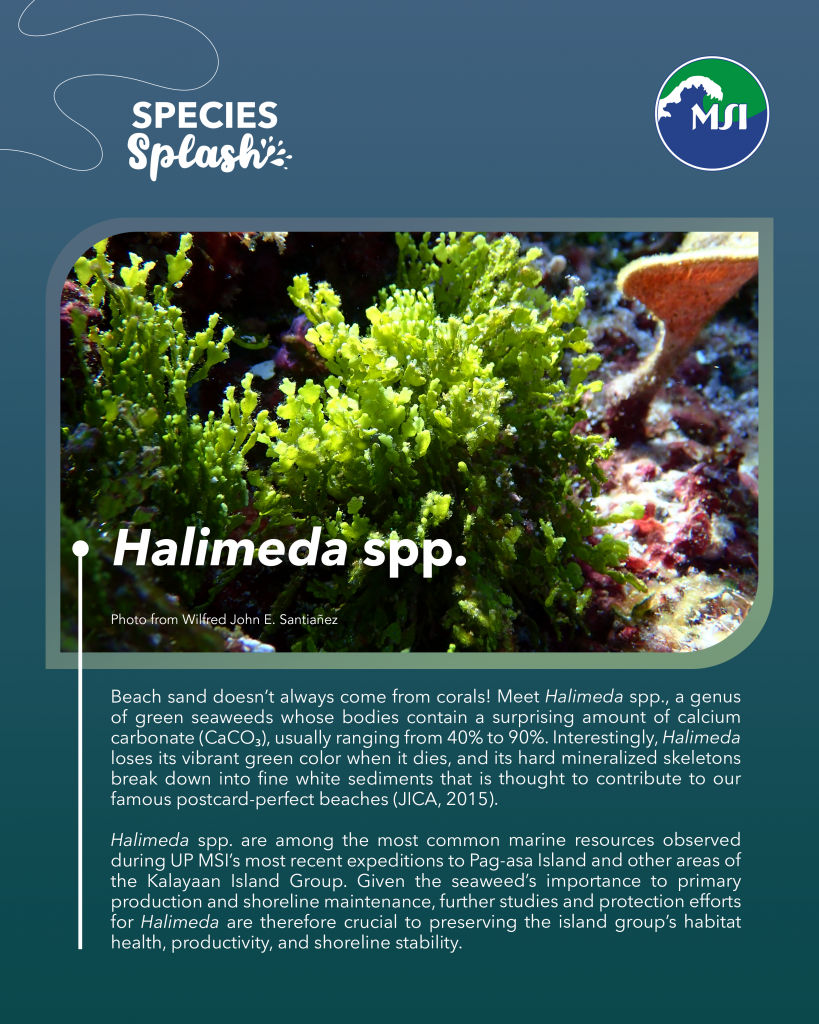
Ever wonder where some of our white sand beaches come from?
Meet the seaweed Halimeda spp.
Halimeda species are remarkable green seaweeds easily identified by their compressed or cylindrical segments that contain a very high percentage of calcium carbonate (CaCO₃), often ranging from 40% to 90% of their entire bodies. When Halimeda dies, its calcium carbonate breaks down into fine sediments that eventually become sand. In fact, a study under the JICA Coastal Ecosystem Conservation and Adaptive Management (CECAM) Project (2010–2015) noted that, aside from corals, the talcum-like white sand found on tropical beaches—such as Boracay—may also originate from Halimeda.
During recent expeditions by the UP Marine Science Institute to Pag-asa Island and its environs within the Kalayaan Island Group, Halimeda was observed to be one of the most common marine resources in the area. Given its crucial role in primary production and contributions to (white) sand formation, the presence of Halimeda underscores the importance of healthy reef ecosystems in maintaining island coastlines. This is especially significant for island communities such as in Pag-asa Island. Protecting reef-associated seaweeds like Halimeda is therefore crucial to ensure productivity of the area and reduce vulnerabilities of marine and coastal communities.
Through the Marine Phycology Laboratory and the Gregorio T. Velasquez Herbarium led by Dr. Wilfred John Santiañez, the team continues to assess algal biodiversity within the area. At present, ongoing marine scientific research for conservation in Pag-asa Island is being supported by the Embassy of Canada in the Philippines through the Canada Fund for Local Initiatives (CFLI). This provides baseline information that supports and promotes the ecological value of Pag-asa Island’s surrounding marine ecosystems.
Meet some of the scientists studying the biodiversity of the West Philippine Sea: https://www.facebook.com/upmarinescienceinstitute/videos/811107138398039/
References:
Cornwall, C. E., Carlot, J., Branson, O., Courtney, T. A., Harvey, B. P., Perry, C. T., Andersson, A. J., Diaz-Pulido, G., Johnson, M. D., Kennedy, E., Krieger, E. C., Mallela, J., McCoy, S. J., Nugues, M. M., Quinter, E., Ross, C. L., Ryan, E., Saderne, V., & Comeau, S. (2023). Crustose coralline algae can contribute more than corals to coral reef carbonate production. Communications Earth & Environment, 4(1), 105. https://doi.org/10.1038/s43247-023-00766-w
Japan International Cooperation Agency (JICA). (2015, May 28). JICA, Japanese, Filipino scientists’ project backs conservation of highly endangered’ Boracay ecosystem. Archived by the National Diet Library, Japan. https://warp.ndl.go.jp/…/office/topics/news/150528.html
Schubert, N., Alvarez-Filip, L., & Hofmann, L. C. (2023). Systematic review and meta-analysis of ocean acidification effects in Halimeda: Implications for algal carbonate production. Climate Change Ecology, 4, 100059. https://doi.org/10.1016/j.ecochg.2022.100059