
Kappaphycus alvarezii – Species Splash
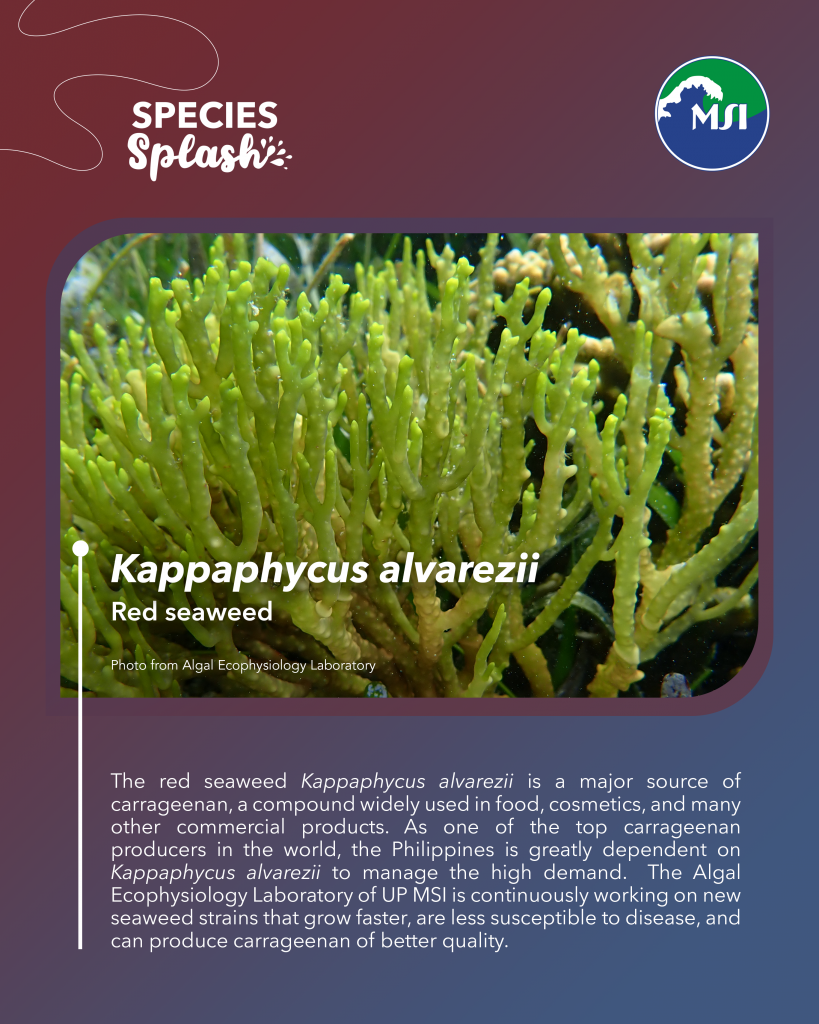
What do ice cream, moisturizer, and air freshener have in common? The answer might be sweeter than you think! 
Not all red seaweeds are red, but they all have a special ability to store sugars in their cells that other seaweeds can’t. One example of a red seaweed is Kappaphycus alvarezii: a major source of carrageenan, a polysaccharide that is used in a variety of commercial products. Carrageenan’s natural gel-forming ability as a hydrocolloid makes it an ideal thickener and stabilizer. Kappaphycus alvarezii has been the cornerstone of the Philippine seaweed industry since farming efforts began in the 1970s, with the commercial Tambalang cultivar being the most popular variant used by farmers. However, most strains used now are clones of older seaweeds, and new strains are needed to sustain the industry against crop failures and disease.
Jonh Rey Gacura, Dr. Michael Roleda, and their team at the Algal Ecophysiology Laboratory collaborated with BFAR Eastern Visayas to develop new strains of Kappaphycus alvarezii from spores of wild parental plants. Among the strains they test-planted in Guiuan, the TR-S8 strain showed the most potential. This strain grew just as fast as the commercial Tambalang cultivar and was less susceptible against ice-ice disease syndrome, making it suitable for short-term cultivation. The TR-S8 strain is already ready for sending to collaborators and test planting in other regions in the Philippines.
This study was funded by DOST PCAARRD. Read the full paper: https://doi.org/10.1016/j.aquaculture.2025.742916
Learn more about the use of carrageenan in commercial products here.